

Basement Waterproofing
A dry basement for good, with the right system for your property!
Effective basement waterproofing protects the structure from water pressure, damp and flooding. Under BS 8102:2022, the British Standard for protecting below-ground structures, there are three main types of waterproofing: A, B and C. At Crystal Damp Proofing & Basements Ltd, we survey your basement, explain what is causing the problem and choose the system, or combination of systems, that will keep it dry for the long term. We work on homes and commercial properties across London and the South East.
Type A: Barrier Protection (Tanking)


Tanking means applying a continuous waterproof coating to the walls and floor of the basement. Put simply, it creates a sealed “box” that physically blocks water.
- External waterproofing: used on new builds, or where the ground around an existing building can be excavated. Bituminous or polymer membranes, sprayed bituminous coatings or mineral slurries stop water before it gets into the masonry. We use sprayed bituminous coatings especially on external retaining walls.
Internal waterproofing: used in older buildings, where digging outside is not possible. We apply cement-polymer tanking slurries designed to resist water pressure from the outside, and where needed we inject resin (polyurethane or acrylic) into the wall to seal cracks and active leaks first.
Type B: Structurally Integral Protection

Here the structure itself keeps the water out. It is designed into new basements and concrete structures:
- Waterproof concrete: special admixtures, including crystalline ones, greatly reduce the porosity of the concrete.
- Sealed construction joints: waterstops, swelling bentonite strips or injection hoses seal the joints between the floor slab and the walls, which are the most common route for leaks.
On new structures we work alongside the structural engineer and, where the risk is higher, add a Type A or Type C system as a second line of defence.
Type C: Drained Protection (Water Management)

This system accepts that some water may get through the structure. Instead of fighting it, it collects the water and removes it safely:
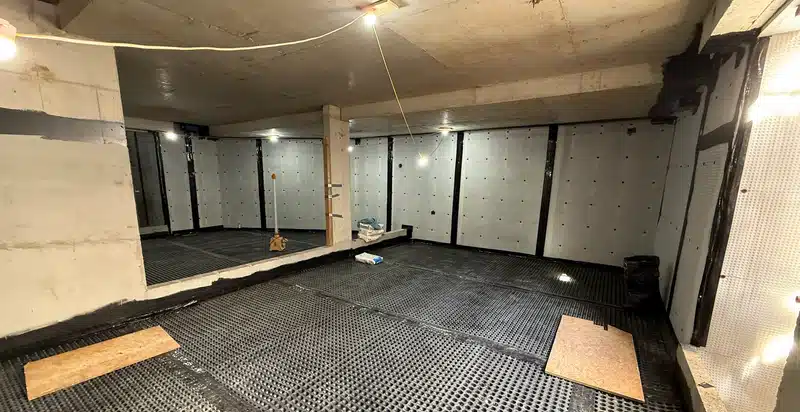
- Cavity drain membranes and drainage channels: studded HDPE membranes are fixed to the inside of the walls and floor. They create an air gap through which water runs down by gravity into perimeter drainage channels.
- Sump pumps: the channels carry the water to a sump chamber, where an automatic pump discharges it outside the building, with battery back-up and a second pump for extra safety.
Type C is the most popular and least invasive repair method for basements that are already finished or used as living space.
Can You Choose the System Yourself?
It is better not to. Every basement is different: the ground, the water level, the condition of the walls and how you want to use the space all affect the choice. BS 8102:2022 recommends that a waterproofing specialist is involved from the start of the design. Our CSSW-qualified surveyors will:
- find the cause and source of the damp or water,
- check the walls, floor, drainage and ground conditions,
- recommend Type A, B or C, or a combination such as A+C, explaining why,
- give you a clear written quote and guarantee.
Damp Patches Spreading on the Walls? Which System Do You Need?

Wet patches on basement walls can have several causes: water pushing through from the ground, rising damp, a leaking pipe or condensation. The treatment depends on the cause, so we always diagnose it first.
- For storage or utility rooms with occasional damp, internal tanking (Type A) is often enough.
- For living space, or where patches keep coming back after rain, we recommend a cavity drain membrane system (Type C), often combined with tanking (A+C) for extra security.
If the cause is condensation or rising damp, we deal with that problem directly, with ventilation, insulation or a damp proof course, rather than covering it up.
Wet Patches on the Floor After Rain? What to Do

Water on the basement floor after rain means the groundwater has risen or rainwater cannot soak away fast enough. Before you call us:
- move anything valuable off the floor and switch off electrics in the area if water is near sockets or appliances,
- check gutters, downpipes and external drains, and make sure the ground outside does not slope towards the house,
- take photos of where the water appears and after how much rain.
Then book a survey. If the water is coming up through the floor or the wall-floor joint, the solution is usually a floor membrane with perimeter drainage channels and a sump pump.
Will Waterproofing Work if Water Collects on the Floor After Rain?

Yes, as long as the system is designed for water under pressure. A coating on its own may not cope in the long run, because London Clay holds water and the pressure after heavy rain can be high. That is why, where water stands on the floor, we use a system that manages it: a Type C membrane with drainage channels and a sump pump, often combined with tanking on the walls. Designed and installed properly, it keeps the basement dry even after heavy rain.
Qualified Specialists & a 10-Year Guarantee
Our family-run team holds CSSW qualifications, with a minimum of 10 years’ experience each. We back our work with a 10-year guarantee covering workmanship, plus a QANW Insurance Backed Guarantee that transfers to the new owner if you sell your property. Based in Croydon, we work on domestic and commercial properties across London and the South East.
See What Our Clients Say
We are proud of our 5-star Google rating: see our reviews. If your basement is damp or takes in water, book a survey in our Booking Survey section, or call or message our fully qualified advisors.
