

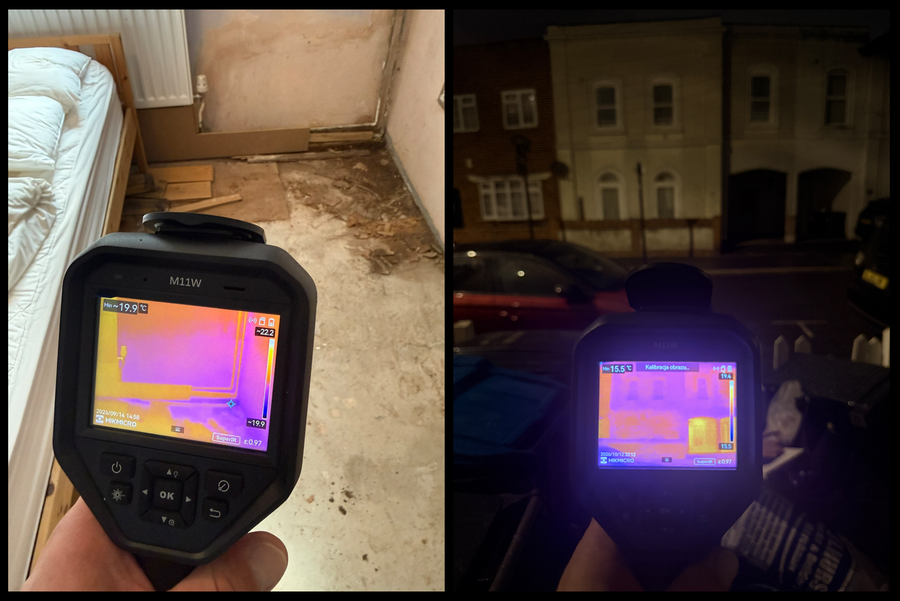
Thermal Inspection
See what the naked eye cannot: find damp before it does serious damage!
A thermal imaging inspection, carried out both inside and outside the property, is one of the most effective ways to diagnose damp problems. A thermal camera does not see moisture itself, but it measures surface temperature. Wet building materials hold heat differently and lose water through evaporation, so they are cooler than dry areas. On a thermal image, damp almost always shows up as a distinctive dark blue or purple “cold patch”. At Crystal Damp Proofing & Basements Ltd, our CSSW-qualified surveyors use thermal imaging to find the real source of damp quickly and precisely.
What a Thermal Inspection Shows


Damp high up on walls (roofs, gutters, facades)
- Outside: the camera locates cracks in the facade, leaks around gutters and faulty flashings at height, and shows the paths water takes beneath the render or into the wall.
- Inside: it shows the full extent of water damage in corners below the ceiling, often revealing damp patches before they appear as visible stains on the plaster.
Penetrating damp, condensation or a leaking pipe?
The camera clearly tells these apart by the shape and position of the temperature differences:
- Penetrating damp: irregular, spreading cold areas that start right at the point of entry, such as a window frame or a crack in the wall, especially after rain.
- Condensation and thermal bridges: neat, geometric lines of cold along lintels, ring beams, room corners or around the whole window. They show where the wall is poorly insulated and heat is escaping.
- Plumbing leaks: a leaking hot water pipe shows instantly as a bright red or yellow line or patch of heat. A cold water leak shows as a sharp, localised cold patch that does not depend on the weather.
Does the plaster need to be removed?
Thermal imaging shows how far the damp has spread inside the wall. The eye may see a 20 cm patch, while the camera reveals that the masonry is soaked across a whole metre. This tells us exactly where the plaster is still sound and where it must be removed, always with a safety margin.
Can a Thermal Inspection Detect Most Damp Problems?


Yes, most of them, on one key condition: there must be a large enough temperature difference (delta T) between the inside and outside of the building, ideally at least 10–15°C. That is why thermal inspections of buildings are most accurate during the heating season, from autumn to spring.
What the camera detects with ease:
- leaks in roofs, terraces and balconies,
- gaps in thermal insulation (thermal bridges that lead to mould),
- leaks around windows and doors,
- leaks from underfloor heating and from hot and cold water pipes,
- the extent of rising damp in basements and cellars.
What a thermal camera cannot detect on its own:
- Damp in summer: if it is 20°C both inside and out, the camera may show no clear differences, unless there is very strong evaporation, and even then the result can be unclear.
- Dry mould: if the source of moisture has been cut off and the wall has dried, but mould remains, the camera will not show anything unusual.
- The exact moisture content: the camera only shows where the surface is colder, and therefore probably wetter. To confirm how deep and serious the problem is, we always also use a moisture meter.
How to Prepare Your Home for an Accurate Inspection
A few simple steps make the results far more precise:
- Keep the heating on: run the heating at a steady, normal temperature for at least 24 hours before the inspection, so there is a clear difference between the inside and outside temperature.
- Close windows and doors: keep them closed for several hours beforehand, so draughts do not cool the walls and blur the image.
- Move furniture away from walls: pull furniture, beds and wardrobes away from the walls to be checked, ideally the day before, and take down pictures, mirrors and heavy curtains so the surface temperature can settle.
- Avoid creating extra moisture: do not dry washing indoors, take long hot showers or cook with open pans just before the inspection.
- Turn on hot water and heating circuits: if a pipe leak is suspected, run the hot water or underfloor heating beforehand so a leak shows clearly.
- Allow access: make sure we can reach the loft, cellar, basement and all affected rooms, as well as the outside walls.
- Tell us the history: let us know when the damp appears, for example only after heavy rain, and about any past leaks or repairs.
For the outside of the building, the best results come in the early morning, in the evening or on an overcast day, without direct sunlight on the facade, strong wind or rain during the inspection. For suspected penetrating damp, it is ideal to carry out the inspection soon after a period of rain, once the outer surface of the wall has dried.
Why Choose a Professional Thermal Inspection?
Ordering a thermal inspection is an excellent first step. It avoids searching for the cause by trial and error and knocking out half the house. Our surveyors do not just point to a dark patch: they interpret its shape and behaviour, combine it with moisture meter readings and give you a clear answer about where the water is coming from and how to fix it.
Free Consultation and Survey
Call us for a free consultation or survey. Surveys more than 10 miles from our base are charged according to our price list. Based in Croydon, we work on domestic and commercial properties across London and the South East.
Qualified Specialists & a 10-Year Guarantee
Our family-run team holds CSSW qualifications, with a minimum of 10 years’ experience each. We back our work with a 10-year guarantee covering workmanship, plus a QANW Insurance Backed Guarantee that transfers to the new owner if you sell your property. Based in Croydon, we work on domestic and commercial properties across London and the South East.
See What Our Clients Say
We are proud of our 5-star Google rating: see our reviews. If your basement is damp or takes in water, book a survey in our Booking Survey section, or call or message our fully qualified advisors.
