


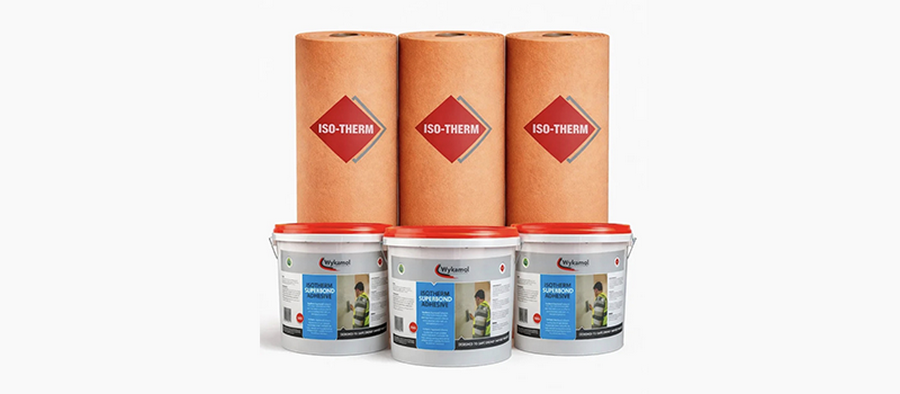
ISO-Therm Membrane & Black Mould
Warmer walls, less condensation and no more black mould, with almost no loss of room space!
ISO-Therm is an ultra-thin, patented polyester thermal insulation membrane, around 4 mm thick, applied to the inside of the building. It raises the surface temperature of cold walls and helps fight damp and mould at the same time. Together with the adhesive and a thin skim of plaster, the whole system is only around 10 mm thick, so it takes almost nothing away from the room. It is ideal for renovating older buildings where the outside walls cannot be insulated externally.
What Does ISO-Therm Do on the Wall?


Its main job is to remove the “cold wall” effect by raising the temperature of the wall surface, while also forming a barrier against damp:
- Condensation: a warmer wall surface means warm, moist air inside the room no longer condenses on it, which greatly reduces the risk of mould and fungi.
- Lateral damp and salts: the membrane is waterproof, so it stops moisture and harmful building salts (nitrates and chlorides) moving from inside the masonry to the surface, protecting plaster and paint.
- Breathable: at the same time, it lets water vapour pass, so the wall can still release moisture naturally.
Does It Help With Thermal Bridges?
Thermal bridges are places where insulation is interrupted or insufficient, such as wall corners, wall-to-floor and wall-to-ceiling junctions, and around windows and doors. Heat escapes through them, heating bills go up, cold spots form on the walls, and condensation and mould follow.
ISO-Therm reduces the effect of these thermal bridges. At around 4 mm thick, it will not replace full external insulation, but it effectively breaks the cold path at the most vulnerable points, such as corners, window reveals and around sockets, reducing heat loss in those areas.
Does It Keep Rooms Warmer?
Yes. According to the manufacturer’s testing, ISO-Therm improves the U-value of a solid brick wall by more than 21%. The wall immediately feels warmer to the touch, rooms heat up faster and heating bills can come down.
Where We Recommend Installing ISO-Therm


- External walls: we recommend installing ISO-Therm on external walls, continuing onto the adjoining internal partition walls for around 1 metre from each corner, where cold spots and mould most often appear.
- Rooms with black mould: it is an excellent solution where black mould and other fungi grow on cold or frost-affected walls.
- Older properties: solid-wall homes where external insulation is not possible or not permitted.
Does the Plaster Need to Be Removed?
Not necessarily. ISO-Therm can be bonded directly onto existing plaster, as long as it is sound and stable, does not sound hollow, and the wall has no active penetrating damp. The system copes with residual moisture and condensation, but not with a serious building defect such as a leaking pipe or failed foundation waterproofing.
What If There Is Penetrating Damp?
Where walls are wet or stained by penetrating damp, simply sticking ISO-Therm over the top would only trap the moisture in the wall. That is why we always follow a strict procedure:
- Remove the source of the water: we find and deal with the cause first, such as gutters, downpipes, flashings, a damaged facade or plinth, or a leaking pipe.
- Check for hollow plaster: we tap-test the walls and remove any hollow or blown plaster back to bare masonry, with a margin of around 50 cm around the damp patch, to stop mould spreading further.
- Treat mould: the cleaned wall is thoroughly treated with a professional fungicide and left to dry in line with the product data sheet.
- Replaster: we fill the areas with new, breathable cement-lime or renovation plaster.
- Allow the new plaster to dry: we wait a minimum of 7 days before applying ISO-Therm, and longer where the plaster is thicker, as a rough guide around 1 day for every millimetre. Before installation, we check with a moisture meter that the wall is completely dry.
- Install ISO-Therm: we prime the whole surface, bond the membrane with the system’s breathable mineral adhesive applied with a notched trowel, and press it down with a rubber roller to remove any air pockets, before finishing with a thin skim.
Ventilation After Installation


Once ISO-Therm is installed, rooms hold their heat better, which can affect how water vapour behaves inside. That is why we recommend:
- Passive vents: at least a passive vent in the room, so it can release water vapour and condensation does not settle on the windows.
- Window trickle vents: to improve air circulation, letting fresh air in and moist air out.
- A dehumidifier: worth using even when the walls show no signs of damp.
Why We Also Recommend DPC Injection behind the skirting( bottom parts of the wall)


Rising damp can affect both the walls and the ISO-Therm membrane, even when it is not yet visible. That is why we also recommend a DPC injection to minimise the risk of rising damp and give the new system the best possible protection.
Qualified Specialists & a 10-Year Guarantee

See What Our Clients Say
We are proud of our 5-star Google rating: see our reviews. If your basement is damp or takes in water, book a survey in our Booking Survey section, or call or message our fully qualified advisors.
